The Future of Our Universe is Bright. Really, Really Bright.
By Alex Zhang, C2ST Intern, DePaul University
“Are we alone in the universe?” For thousands of years, the question has stumped humanity. Through icons like E.T., the Alien franchise, and most recently Project Hail Mary, our fascination with the extraterrestrial has dominated popular culture and media for generations. But the search for life isn’t just contained in scripts or on film reels; scientists in a dizzying number of hyper-specific fields make daily progress expanding our knowledge of space, getting us ever so closer to answering that burning question. One such discovery has been pivotal in that task, providing stepping stones to understanding the universe in completely unexpected ways. This is the history and science of Fast Radio Bursts (FRBs).
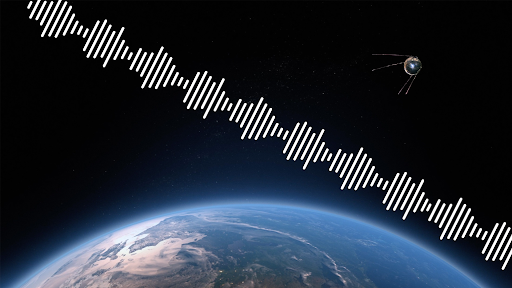
In 2007, an assistant professor of physics at the University of West Virginia sat down for a meeting with an undergraduate student. Their goal was to discuss the manual observations of the student, Ash Narkevic, who had been combing through visual data from the Parkes Radio Telescope in Australia. While radio is often thought of as an audio-only format, it is actually part of the electromagnetic spectrum, a way of categorizing radiation created using electric and magnetic fields. That same spectrum includes visible light, which is useful when thinking about how we can “see” radio waves. Of course, the naked eye can’t accomplish this. But inventions like the radio telescope allow us to create images from radio waves, displaying them in formats like graphs (that look like an EKG reading) and vibrant images, which can display radio wave size and structure. Through analyzing one of these visualizations, Ash and Dr. Duncan Lorimer discovered an extremely unusual anomaly.
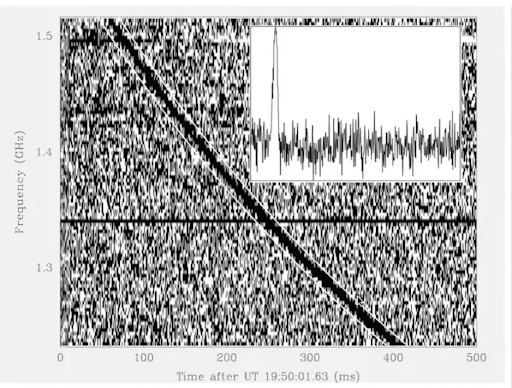
(Example of two different formats we can visualize radio waves in. Courtesy of Professor Victoria Kaspi and her 2021 Bakerian Lecture for the Royal Society.) Image #2
See, the reason that the two were studying the Parkes data in the first place was the presence of little green men. Well, that’s kind of true. The reality is that in 1967, the telescope picked up short radio pulses from space so unlike the typical that they appeared to be artificial in origin. As a half-joke, the scientists named the first pulse “LGM-1,” short for Little Green Man 1. Unfortunately for UFO fanatics, scientists at the time quickly found the “pulsars” were emitted by the birth of neutron stars. But in science, everything is worth studying! As such, Ash and Dr. Lorimer combed through the pulsar data to find anomalies; a routine inspection led to the observation of a completely different kind of pulse – one that was extremely bright within the electromagnetic spectrum. The amount of electromagnetic radiation that this pulse had was extraordinary: it created more energy in a single burst than our sun does in a full year! In fact, it was so bright and powerful that using math, researchers concluded it must be emanating from another galaxy.
Following this discovery, a renewed effort to observe space radio waves yielded hundreds of these pulses, which were named Fast Radio Bursts (FRBs). It was very clear the FRBs were extragalactic (from other galaxies), but their exact origin remains a mystery to this day. Through complex astrophysics equations, scientists determined that the distance, size of the emitting region, and brightness were evidence of an “emission mechanic.” Put more simply, the radio waves were being shot out of something massive and catastrophic, like the birth or death of a star. Thus, the leading theory of FRBs being caused by magnetars – which are intensely magnetic neutron stars – was born. If the magnetic fields of these magnetars were somehow disturbed by a cataclysmic event, many believed it could cause an FRB to explode out into space. While we are still unsure of whether this is correct, looking at some prominent FRB examples can help us theorize even more.
The farthest FRB ever recorded was traced back to an ancient section of the universe, one enveloped in the chaos of seven possible galaxies colliding. This galactic cluster, which formed 8 billion years earlier than the Earth, is also the most powerful FRB we’ve ever traced. Here’s to hoping one of you at home can solve this mystery – the best astrophysicists in the world haven’t figured it out yet! The brightest FRB to date was traced back to a galaxy 130 million light-years away from Earth, actually contained within the Big Dipper Constellation. In fact, the location of RBFLOAT (radio-brightest-flash-of-all-time and some great science humor) was pinpointed so precisely that its place within a star-forming region of the galaxy seems to support the magnetar theory.
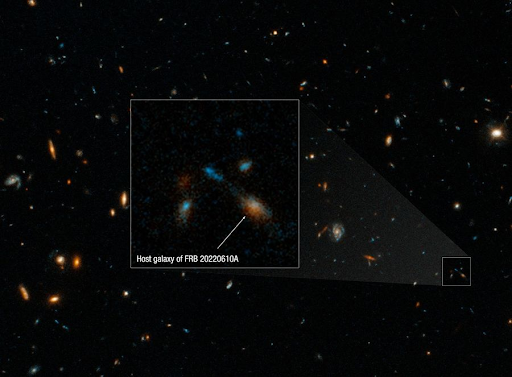
(An image of the birthplace of the farthest FRB recorded. Courtesy of NASA’s Hubble Space Telescope). Image #3
As to whether or not extraterrestrial life exists, it’s still anyone’s guess. But FRBs are incredibly useful in our search out there, not only as unexplainable phenomena but also as a tool for universal mapping. When FRBs travel through space, they hit random bits of matter scattered about. This isn’t planets or stars, but rather the empty space in between galaxies. Much like light through a prism creates a rainbow, the FRBs leave streaks or smears across the universe as they pass through floating matter. Observing these streaks can help us visualize a full map of the universe; not only of the visible galaxies, but of the invisible space between them. Eventually, this may lead to exact measurements of distances between everything in space, a necessity for intergalactic space travel and the search for aliens.
In reality, FRBs leave more questions than answers for us. What causes them? Where exactly do they come from? How come some of them repeat while others don’t? With luck, we’ll find the answers to some of these questions soon. Increasingly advanced technology is only generating more precise information about FRBs, and the recent hype around missions to the moon seems to be reinvigorating humanity’s space-faring dreams. Perhaps the fast radio bursts hold the key to infinite energy, like Project Hail Mary’s astrophage. Or maybe they’re a natural consequence of universal processes we just don’t understand yet. At the very least, one thing is for certain: we can’t rule out the possibility of little green men.
——————————————————————————————————–
Raw FRBs Data: https://www.chime-frb.ca/