Pros and Cons of Protein in American Football

By Ezewani Nkwo, C2ST Intern, Northern Illinois University
Football culture at elite levels, such as the NFL and major college programs, heavily depends on protein. It is common in team nutrition programs, post-workout meals, and protein smoothies in the locker room. However, it’s not as straightforward as “more is better” when it comes to performance. All levels of athletes should be aware of the advantages and disadvantages of protein.
The Role of Protein in the Body (Muscle Development)
Protein is vital in the growth and repair of muscle tissue during exercise and competition. Protein helps athletes rebuild their muscles when they break down during training. According to research, in order to maintain muscle growth and repair, athletes normally require 1.2–2.0 grams of protein per kilogram of body weight per day.
For this reason, in order to retain their size, strength, and power, football players, especially those in positions like linemen, place a heavy focus on protein intake. Regular protein consumption and exercise eventually result in greater muscle mass, enhanced strength, and increased performance.
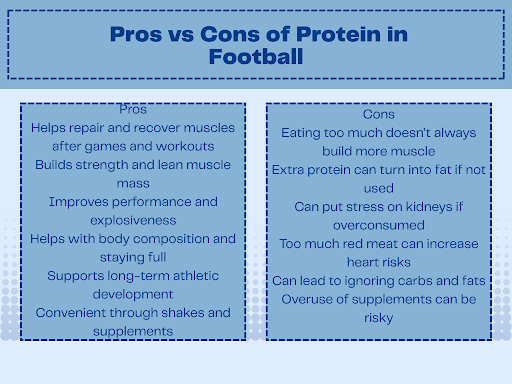
The chart below describes the effect of protein, pros and cons, on the body. While these effects can vary depending on the individual person, scientists have shown, for the most part, that protein is essential for healthy bodily functions.
Pros of American Football with Protein
Protein is essential for muscle repair and recuperation, particularly following intense exercises, competitions, and weight training. It speeds up athletes’ recuperation so they can resume high-level performance. Strength and muscle growth are also crucial for jobs that depend on strength and size. Higher protein consumption promotes the growth of lean muscle and increases strength.
Additionally, protein improves performance in power and explosiveness exercises, including lifting, tackling, and sprinting. Additionally, it promotes body composition, assisting athletes in losing fat without sacrificing muscle.
Types of Protein
Not every protein is created equal. Because they contain less harmful fat, lean sources like poultry, fish, eggs, and plant-based foods like lentils and beans are preferable choices.
Protein smoothies are popular because they are simple and quick, especially after working out. However, because they contain more nutrients overall, whole foods are typically superior. Over time, diets heavy in red or processed meat have been associated with higher health risks.
Cons of American Football with Protein
One of the primary issues with protein intake is overconsumption. Increased protein intake does not always result in increased muscle growth because the body stores extra protein as fat or uses it for energy once it has enough (International Society of Sports Nutrition). The kidneys may also be stressed by a high protein diet, especially if it surpasses 2.0–2.5 g/kg daily and there is enough hydration (Mayo Clinic). Football players, who already lose a lot of water through perspiration, should pay particular attention to this.
Furthermore, there may be hazards to heart health, especially if the protein comes from processed or high fat meats, which have been connected over time to high levels of cholesterol (Harvard T.H. Chan School of Public Health). Another worry is that players can overlook other vital nutrients, such as carbs, which are the body’s main energy source for intense workouts like football.
Lastly, it can be risky to rely too much on supplements. It has been discovered that several protein powders and supplements include prohibited or dangerous ingredients, such as stimulants, anabolic agents, or harmful substances not specified on the label. The National Collegiate Athletic Association states that certain stimulants, selective androgen receptor modulators (SARMs), and anabolic steroids are forbidden because they can unfairly improve performance and pose significant health hazards. In addition to health problems, using tainted supplements can result in drug test failures and competitive bans for collegiate athletes.
All things considered, protein is important for football performance, especially at the highest levels when muscular growth, strength, and recuperation are crucial. Protein supports body composition, enhances performance, and repairs muscles. However, an excess of protein can result in health hazards like renal stress, fat gain, and an unbalanced diet. Even while protein is necessary, athletes should be aware that it must come from healthy sources and be ingested in the proper amounts. The ideal strategy for long-term performance and general health is a well-balanced diet that contains protein, carbs, and fats.
References
- International Society of Sports Nutrition. (2017). Position Stand: Protein and Exercise.
https://jissn.biomedcentral.com/articles/10.1186/s12970-017-0177-8 - Harvard T.H. Chan School of Public Health. (n.d.). Protein: Sources and health effects.
https://www.hsph.harvard.edu/nutritionsource/what-should-you-eat/protein/ - National Institutes of Health. (2022). Dietary protein and health outcomes.
https://ods.od.nih.gov/Research/dsrp.aspx - Mayo Clinic. (2023). Protein intake and kidney health.
https://www.mayoclinic.org/healthy-lifestyle/fitness/in-depth/performance-enhancing-drugs/art-20046134 - National Collegiate Athletic Association. (n.d.). Banned Substances List.
https://www.ncaa.org/sports/2015/6/10/ncaa-banned-substances.aspx